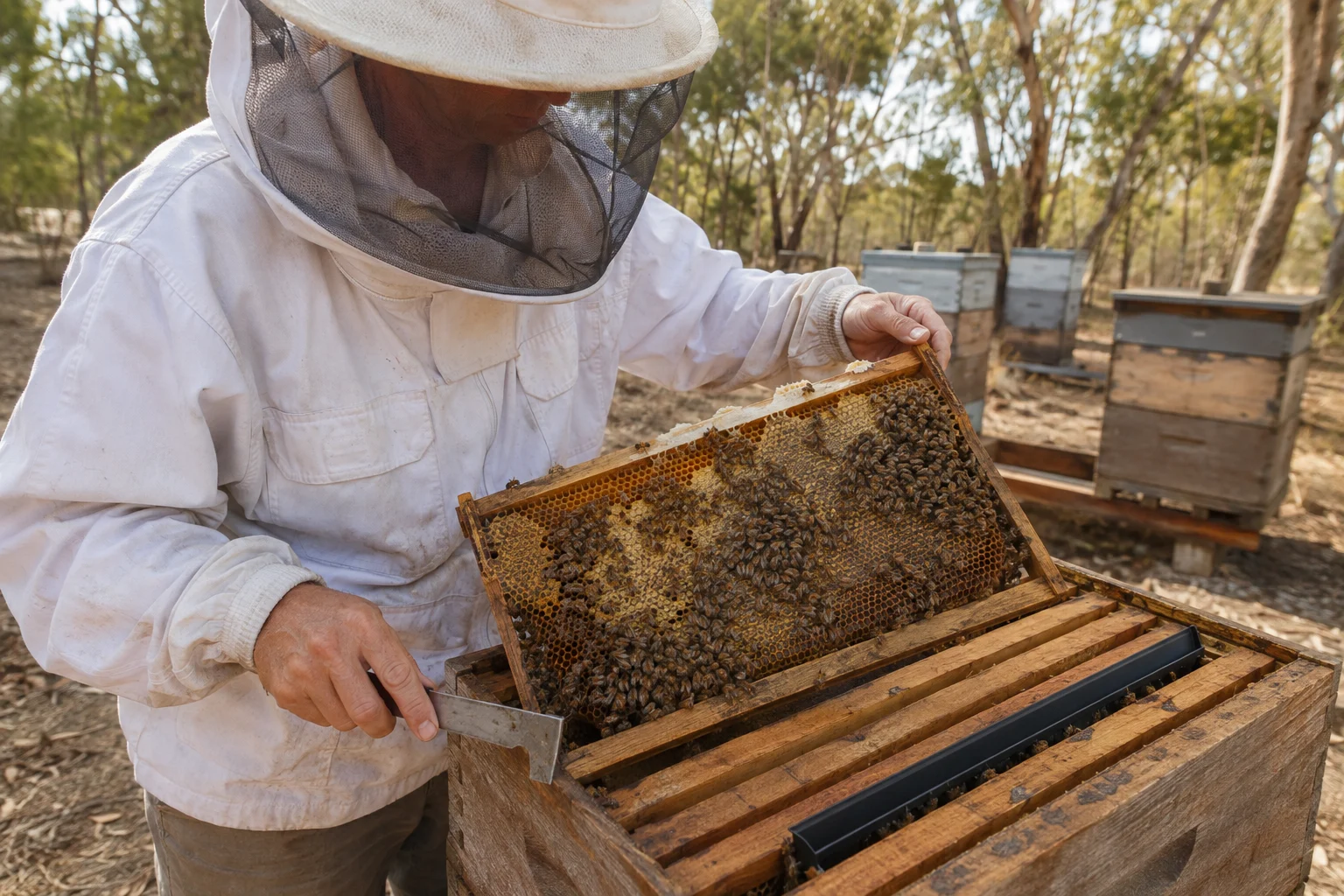

Varroa destructor has reshaped beekeeping across Australia, making structured monitoring and treatment essential for hive survival. The aim of this guide is to help both hobby and commercial beekeepers understand the main treatment options available, how they work, and when they are most effective. Information is based on published guidance from the NSW DPI, Australian Honey Bee Industry Council (AHBIC), and international scientific reviews (Rosenkranz et al., Journal of Invertebrate Pathology, 2010).
Formic Pro
Formic Pro uses formic acid in a controlled-release pad, producing vapour that moves throughout the hive. Formic acid is one of the few treatments capable of penetrating capped brood, allowing it to kill mites reproducing inside cells.
Advantages:
-
Reaches mites under capped brood
-
Organic acid (no synthetic residues)
-
Short treatment window
Considerations: -
Temperature-sensitive
-
Can stress queens if used incorrectly
Published research shows formic acid can kill “up to 95% of mites, including those in sealed brood” (Rosenkranz et al., 2010).
Apivar
Apivar contains amitraz, a well-studied miticide used internationally. Strips are placed in the brood box, and bees distribute the active ingredient through contact.
Advantages:
-
Reliable slow-release delivery
-
Gentle on colonies
-
Widely used across commercial beekeeping
Considerations: -
Does not penetrate capped brood
-
Risk of resistance if overused
Studies show amitraz strips maintain effectiveness when used according to label instructions (Berry et al., American Bee Journal, 2020).
Bayvarol
Bayvarol uses flumethrin, a synthetic pyrethroid. It works as a contact kill—bees moving across the strips spread the active ingredient throughout the colony.
Advantages:
-
Easy to apply
-
Effective when mite levels are moderate
Considerations: -
Resistance documented in several countries
-
Does not reach mites in capped brood
Pyrethroid treatments remain effective where resistance is low but require monitoring to avoid overreliance.
Apiguard
Apiguard is an organic thymol gel, widely valued for keepers seeking a natural approach.
Advantages:
-
Natural essential-oil-based ingredient
-
Effective in warm climates
-
Gentle on brood
Considerations: -
Less effective in cold weather
-
May slow brood production temporarily
Thymol has been shown to reduce mite loads by 65–95% depending on hive strength and temperature (Imdorf et al., Apidologie, 1999).
Alcohol Wash Kit
Alcohol washing remains the most accurate mite-counting method. It provides a hard number of mites per 300 bees, allowing informed decisions on when to treat.
Advantages:
-
High accuracy
-
Strong scientific validation
Considerations: -
Sacrifices a small number of bees
NSW DPI recommends alcohol washing as the “most reliable and repeatable method” for assessing mite loads.
Sugar Shake Kit
Sugar shaking offers a gentler testing alternative, using icing sugar to dislodge mites without killing bees.
Advantages:
-
Non-destructive
-
Good for quick checks
Considerations: -
Less accurate than alcohol wash
-
More variable results
Useful for hobbyists or educational settings, but not a substitute for alcohol tests before major decisions.
Choosing the Right Method
Every treatment has strengths and limitations. The best approach for your apiary depends on:
-
Seasonal timing
-
Brood levels
-
Temperature
-
Your preference for organic vs. synthetic treatments
-
Resistance management
-
Hive strength and queen condition
Most experts recommend a rotation strategy to prevent resistance and maintain long-term mite control (AHBIC, 2023).